
NOISE MONITORING IN SAUDI ARABIA
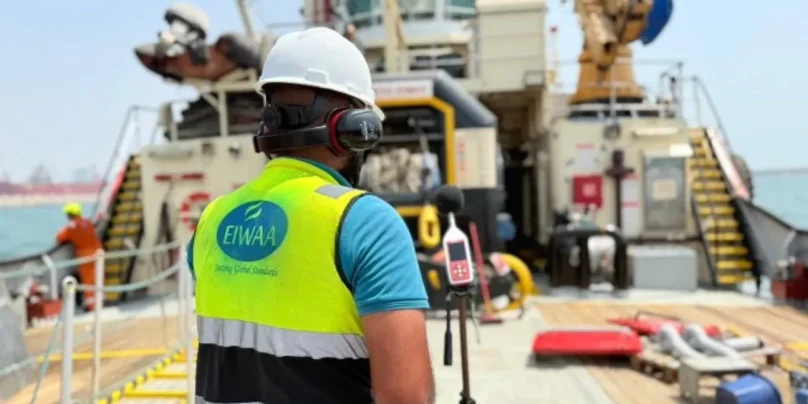
Get Noise Monitoring and sound monitoring certifications from accredited third-party inspection companies in Marine and offshore sectors to meet IMO Regulations and ship classification rules. EIWAA Marine Services provides sound level measurement, remote noise monitoring surveys, noise testing and third-party inspection at ships, boats, yachts, platforms and offshore rigs. Measurements of decibel meter levels at engine rooms, deck, fabrication areas, drilling areas, and other areas of ships, vessels, offshore platforms, Offshore Rigs, Refineries, Power plants etc. Pumps, engines, boiler rooms, and mooring stations are examples of marine equipment and places for which EIWAA is the ideal offshore noise monitoring solution
Our noise monitoring apparatus may be powered by a battery, solar panel, or line power, which makes it simple to deploy almost anywhere and retrievable for data gathering and analysis. A successful noise control plan incorporates a number of techniques, each specifically designed to meet the requirements of the industrial facility. The first stage is a comprehensive noise evaluation to determine exposure levels and primary sources. A noise monitoring system’s features include data storage, data logging, x GB noise metrics, and a 1/3 octave filter with a 1/1 filter.
NOISE SURVEY IN SHIPS AND OFFSHORE RIGS IN SAUDI ARABIA
Noise Survey services have a great deal of experience controlling and keeping an eye on drilling rig noise. There are numerous primary sources of noise on drill rigs, each with unique features. The actual equipment on the rig determines the overall noise levels. However, our vast expertise in this area has demonstrated that, at 500 feet, drilling rig noise levels typically range from 60 to 65 dBA. Sound levels can be considerably lowered using effective noise control techniques. It is usually possible to achieve reductions of at least 10 dBA. Marine equipment that needs noise assessments and offshore rig noise monitoring includes power sets, shale shakers, mud pumps, top drives, pipe handling, light towers, blowers, air conditioning systems, transportation locations, and engine room space.
Our team of knowledgeable noise experts has conducted noise surveys for numerous sectors for a long time. Their familiarity with regional and global laws guarantees the precision and applicability of our evaluations. You may rely on our knowledgeable staff for precise noise survey services. We offer useful data for regulatory compliance and noise management strategies through thorough surveys and sophisticated noise assessment. We offer accurate data to assess noise levels in various locations using contemporary noise monitoring technologies. This makes it possible for us to recognize any noise risks and put into practice efficient noise reduction strategies.
SOUND LEVEL MEASUREMENT IN SAUDI ARABIA
A sound level meter must adhere to the necessary standards in order to provide accurate and trustworthy results. The majority of measuring regulations specify the specifications that the instrument must fulfill. New meters must meet IEC 61672 (or its British Standard counterpart, BS EN 61672) for Class 1 or Class 2 in order to comply with the majority of legislation. The calibrator, octave band filters, noise dosimeters, personal sound exposure meters, and so on all have additional standards.
- IEC 61672: Electroacoustic sound level meters, IEC 61672 Current measurement regulations will mandate the use of the most recent sound level meter standard. The accuracy grades are Class 1 and Class 2.
- IEC 60651: Sound Level Meter has taken the position of this standard. There are still many uses for older meters that satisfy this condition. This standard was eventually changed IEC 60651 from its original name, IEC 651.
- IEC 60804: IEC 61672 is the replacement standard that replaces it. Its initial name, IEC 804, was later changed to IEC 60804. It addresses the capability of integrating sound level meters and expands upon IEC 60651.