
WINCH LOAD TESTING AND CERTIFICATION IN SAUDI ARABIA
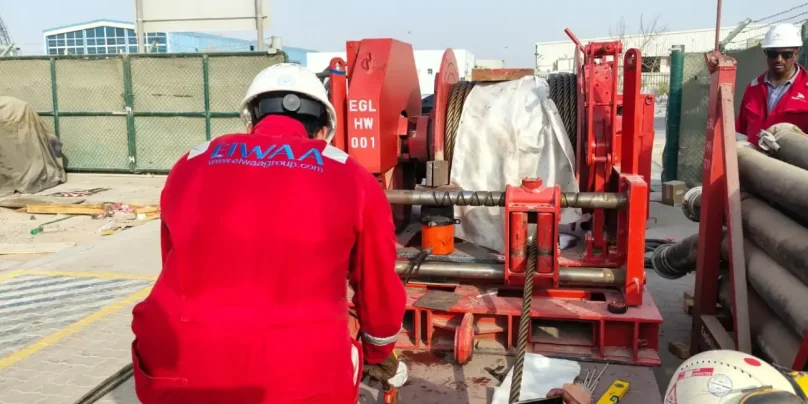
Searching for professional and quality Winch load testing Inspection and certification services…? EIWAA Marine inspection Company provides winch brake holding, brake rendering test, and anchor windlass inspection along with winch load testing and certifications. Types of winch certification includes Anchor handling winch, hydraulic winch, tugger winch, capstan winch , and pneumatic winches of ships, vessels, and offshore rigs. All the winch load testing inspection and certification at onboard ships, and 4-point mooring system by calibrated brake rendering kit, water bags, water weights and dynamometer load cell.
Winch load testing inspection comprises winch brake holding test, winch brake rendering test, and anchor windlass inspection using a portable brake rendering test tool, a standardized load cell, a water bag, test weights, and a digital dynamometer load cell. Our approved rigging engineers work with marine-class-approved surveyors to perform winch certification and load testing on ships, vessels, boats, and yachts. Load testing is followed by winch certification, which ensures the operational safety of the winch erection, mounting foundation, drum and spooling condition, brake holding, and rendering performance. Functional testing and certification of the gearbox, motor, and brake system; SWL verification; overload security; control system and backup functionality; and operational performance of underload situations are the primary checkpoints of winch inspection and certification.
TUGGER WINCH INSPECTION IN SAUDI ARABIA
For the performance, capacity measurement, and operational safety of all types of winches used in offshore and maritime environments. Tugger winch load testing, inspection, and certification in ships, offshore rigs, and vessels adhere to the rules and regulations of,
- According to SOLAS (Safety of Life at Sea) standards Chapter II-1: Machinery and Electrical Installations, mooring equipment shall be inspected for safe lifting activity.
- Rules and regulations for onboard towing and mooring equipment are found in MSC.1/Circ.1175.
- Marine classification guidelines for ship designing mooring configurations, as well as specifications and techniques for appropriate mooring fittings and equipment (MSC.1/Circ.1619, 2019).
- Classification for the Inspection and Testing of Mooring Equipment, specifications, procedures, and guidelines for mooring lines (MSC.1/Circ.1620, 2019).
- ISO 3730:2012: Testing, procedures, and standards for mooring winches.
- ISO 1704:2007: SWL and MBL specifications for shipboard steel wire ropes.
BRAKE RENDERING TEST IN SAUDI ARABIA
To make sure there is no slippage or overload, mooring winches in boats and ships are inspected and tested annually using brake rendering, pull, and holding tests. Mooring winches must be inspected annually and on a regular basis to ensure that the brake rendering and its capacity or slips during any kind of loading at SWL or proof load are not placing undue pressure on the mooring lines and equipment.
The safety assurance, IMO and LEEA standard compliance, controlled testing, and non-destructive assessment services criteria were all confirmed by our mooring winch brake rendering testing kit. The IACS-approved load testing specialists use hydraulic jacks, a calibrated dynamometer load cell, and lifting inspection equipment to test the mooring winch’s proof load and brake holding ability.
WINCH BRAKE HOLDING TEST IN SAUDI ARABIA
The yearly inspection and testing of mooring winches in maritime vessels includes brake rendering, pull, and holding tests to ensure there is no slippage or overloading. To make sure that the brake rendering and its capacity or slips during any type of loading at SWL or proof load are not putting excessive pressure on the mooring lines and equipment, anchoring winches must undergo yearly and periodical checks. Our mooring winch brake rendering testing kit verified the safety assurance, IMO and LEEA standard compliance, controlled testing, and non-destructive evaluation services requirements.
- According to SOLAS (Safety of Life at Sea) standards Chapter II-1: Machinery and Electrical Installations, all mooring apparatus shall be inspected for safe lifting operation.
- Rules and regulations for onboard towing and mooring equipment are found in MSC.1/Circ.1175.
- Marine classification guidelines for ship designing mooring arrangements, as well as specifications and techniques for appropriate mooring fittings and equipments (MSC.1/Circ.1619, 2019).
- Classification for the Inspection and Testing of Mooring Equipment, specifications, procedures, and guidelines for mooring lines (MSC.1/Circ.1620, 2019).
- ISO 3730:2012: Testing, procedures, and standards for mooring winches.
- ISO 1704:2007: SWL and MBL specifications for shipboard steel wire ropes.
ANCHOR WINDLASS INSPECTION IN SAUDI ARABIA
For safe maritime operations and adherence to class requirements, anchor windlass testing and inspection are crucial. Our class surveyors conduct visual inspection, NDT inspection, functional assessments, and pull testing of anchor windlass using calibrated dynamometer load cells, shackles, and slings. NDT examinations that can ensure cracks and linear indicators under overloading include dye penetrant testing, magnetic particle testing, and eddy current testing.
- MSC/Circ.1175: The guidelines for the safe use and testing of anchoring machinery are outlined in the MSC/Circ.1175 Guidance on Onboard Towing and Mooring Equipment.